
Mornings at -5°C, salted roads, fogging that won't go away, a battery struggling to start: winter puts your car through its paces. The good news is that an hour of preparation in autumn avoids most unpleasant surprises. Here is our complete checklist to prepare your Mazda (Mazda 3, CX-30, and other models) before the first cold snap, featuring points specific to recent Mazdas and what the "Loi Montagne" (Mountain Law) requires.
| When to get started | October-November, before the first frosts |
| Duration | Approximately 1 hour for all checks |
| Key points | Tires, battery, visibility, fluids, winter kit |
| Mountain Law | From November 1st to March 31st in relevant municipalities |
1. Tires: grip, pressure, and the Mountain Law
Winter or all-season tires?
Below approximately 7°C, the rubber of a summer tire hardens and loses grip, even on dry roads. Manufacturers place the threshold for the benefits of winter or all-season tires around this temperature. To be effective on snow and recognized by the Mountain Law, they must bear the 3PMSF marking: the three-peak mountain snowflake symbol on the sidewall of the tire.
Check for wear
The legal minimum tread depth is 1.6 mm, which can be identified using the wear indicators in the grooves. On snow and wet roads, however, grip deteriorates well before this point: if your tires are approaching this minimum, it is better to change them before winter rather than during it.
Adjust pressure
Cold weather causes tire pressure to drop, by approximately 0.1 bar for every 10°C decrease. A tire inflated in September may therefore be under-inflated in December, which degrades road handling and increases fuel consumption. Check the pressure while the tires are cold, before driving, by referring to the sticker located in the driver's door frame or in the owner's manual. Some winter tire manufacturers recommend adding 0.2 bar compared to the summer pressure: check your manufacturer's recommendation.
After correcting the pressure, remember to reset the tire pressure monitoring system if your Mazda is equipped with one: the procedure is indicated in the owner's manual.
What the Mountain Law says
From November 1st to March 31st, in mountain municipalities listed by prefectural decree and indicated by signs, cars must:
- either be equipped with four winter tires (3PMSF marking);
- or carry snow chains or snow socks to equip at least two drive wheels.
Since November 1st, 2024, the "M+S" marking alone is no longer sufficient: only tires marked 3PMSF are recognized as winter tires. Before heading to the ski slopes, check the prefecture's website to see if your destination is covered.
2. The battery: the weak point of cold weather
In extreme cold, a battery delivers less energy while the engine requires more to start. Frequent short trips, with heating, heated seats, and defrosting turned on, do not give it enough time to recharge. A tired battery that still held up in summer often fails on the first freezing morning.
- Watch for signs: starter turning slowly, lights dimming when starting, battery more than 4 to 5 years old.
- Have it tested: a service center or garage can check its condition in a few minutes.
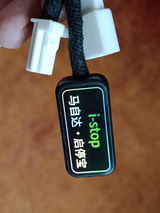
- Replace it with the right type: like all cars with stop-start systems, Mazdas equipped with i-stop use a reinforced battery (EFB or AGM type). If replacing, choose a start-stop compatible battery of the same type as the original.
Good to know: if the i-stop no longer cuts the engine at red lights when it is cold, it is usually not a malfunction. The system does not activate when the temperature is too low, when windshield defrosting is on, or when the battery is not sufficiently charged.
3. Visibility: windshield, wipers, and washer fluid
Switch to winter washer fluid
Summer washer fluid can freeze in the reservoir and nozzles during the first cold nights. Replace it with a product suited to freezing temperatures, such as the Rain-X hydrophobic washer fluid, protected down to -20°C, which also makes rain bead off the windshield.

Note: the Mazda manual indicates that the AUTO mode for wipers may malfunction below -10°C, and that a hydrophobic coating on the windshield may alter rain sensor detection. If wiping becomes irregular, simply switch to manual control.
Check wiper blades
Streaks, stuttering noises, poorly wiped areas: worn blades become dangerous when it rains, snows, and gets dark at 5 PM. Rubber ages with the summer sun, so autumn is the right time to replace them. For the Mazda 3 BP, we offer a complete set of front and rear blades with the correct dimensions. Protective wiper arm caps also prevent water, leaves, and salt from accumulating at the base of the arms.
Defrost without damaging
- Never use hot water on the windshield: the thermal shock can crack it, especially if it already has a chip, and the water refreezes immediately.
- Do not rely on the wipers to scrape ice: you will damage the blades and put strain on the wiper motor. Also, check that they are not frozen to the windshield before turning them on.
- Turn off wipers completely before defrosting or clearing snow from the windshield, as recommended by the Mazda manual: in AUTO mode, with the ignition on, they can trigger and pinch your fingers.
- Use a proper scraper: a high-resistance ice scraper removes frost without scratching the glass, unlike a bank card or CD.
Eliminate fog
Fog comes from the humidity of the indoor air, which condenses on cold windows. To eliminate it quickly:
- keep the air conditioning on: it dries the air, even in winter;
- avoid recirculation mode, which keeps moisture in the cabin;
- clean the inside of the windshield with a microfiber cloth: a greasy film traps moisture;
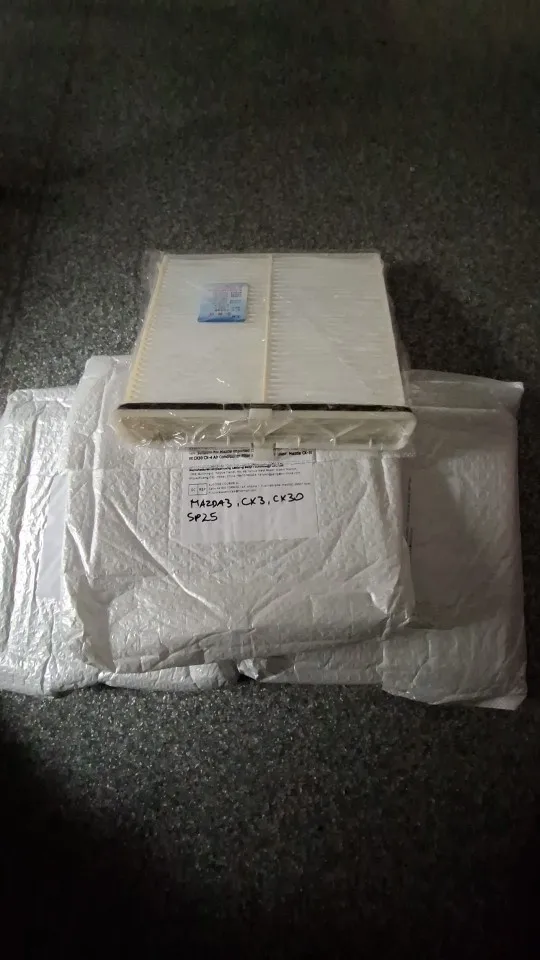
- check the cabin filter: if clogged, it reduces airflow and slows down demisting. Our tutorial explains how to change the cabin filter of a Mazda 3 BP or CX-30 in 10 minutes.
Lighting and sensors
Walk around the car with the lights on: low beams, high beams, fog lights, turn signals, brake lights. LED headlights, like those on recent Mazdas, generate little heat: snow and frost do not melt on them, so they must be cleared by hand before setting off.
i-Activsense driver assistance systems also need to see clearly. Depending on the version, the camera is located at the top of the windshield behind the interior rearview mirror, the front radar behind the Mazda logo in the grille, and the rear radars in the bumper. If covered in snow, ice, or salty mud, some systems may temporarily deactivate with a message on the screen: a quick wipe is enough to restore them.
4. Under the hood: coolant and oil
Coolant
The Mazda manual recommends checking the level at least once a year, particularly before winter. The check should be done with the engine cold: the level should be between the F (full) and L (low) marks on the expansion tank. If it is close to the L mark, top up to the F mark with the coolant recommended by Mazda (FL-22): a different type of fluid can damage the cooling system.
- Never open the cap when the engine is hot: pressurized fluid can spray out and cause severe burns.
- Have the antifreeze protection checked if you are in doubt, for example after topping up with water several times: a garage can measure it in seconds.
- Monitor the level afterward: a regular drop signals a leak that needs to be checked.
Engine oil
If your oil change is approaching, do it before winter: new oil, of the viscosity recommended by Mazda, circulates faster during a cold start. Our tutorials detail the oil, quantity, and each step for the Mazda 3 BP oil change and the Mazda CX-30 oil change.
5. Bodywork and cabin: salt, mud, and moisture
- Rinse off salt regularly: road salt accelerates corrosion, especially under the chassis, in wheel arches, and on the brakes. A high-pressure wash with underbody rinsing every two to three weeks during salting periods limits the damage.
- Protect the rocker panels: mud flaps reduce mud, gravel, and salt spray on the sides. They are available for the Mazda 3 BP hatchback and the Mazda 3 BP sedan.
- Treat door seals: a little silicone grease or a glycerin stick prevents them from freezing shut and tearing when opened.
- Keep the cabin dry: snow and water brought in by shoes soak into the carpet, maintaining humidity and fog. Edged mats like the 3D TPE all-season floor mats for Mazda 3 BP trap water and salt and can be emptied in seconds.
6. The winter kit to keep in the trunk
Being stuck in the snow or breaking down at -8°C is much easier to deal with when you have the right equipment:
- an ice scraper and a small broom or snow brush;
- a pair of gloves and a flashlight;
- a blanket and a bottle of water;
- a microfiber cloth for windows and sensors;
- a spare container of winter washer fluid;
- snow chains or snow socks if you are going to the mountains, tested at home first;
- jumper cables or a booster;
- a phone charger for the car.
The safety vest and warning triangle, which are mandatory all year round, complete the kit.
7. On the road: good habits
- Clear all snow from the car before starting: windshield, windows, mirrors, lights, license plates, but also the roof, from which snow can slide onto the windshield during the first braking.
- Keep at least half a tank: in the event of a prolonged traffic jam, you will be able to keep the heating on.
- Drive smoothly: progressive acceleration, anticipated braking, significantly increased following distances.
- Do not overestimate all-wheel drive: on equipped Mazda 3 and CX-30 models, the i-Activ AWD system helps with starting and maintaining traction, but it does not shorten braking distances.
- In a diesel, before a stay in the mountains during extreme cold, fill up at a station in the region: the diesel there is adapted to low temperatures.
Frequently Asked Questions
When should I mount winter tires?
As soon as morning temperatures consistently drop below 7°C, generally between late October and mid-November. If you are driving in a mountain area, the Mountain Law requires this equipment starting November 1st.
Are all-season tires accepted by the Mountain Law?
Yes, provided they bear the 3PMSF marking (three-peak mountain with a snowflake). A tire marked only "M+S" has not been recognized since November 1st, 2024.
Why does i-stop stop working when it's cold?
This is normal behavior: the system does not cut the engine when the temperature is too low, when windshield defrosting is on, or when the battery is not charged enough. It becomes active again once the conditions are met.
Should I let the engine warm up before leaving?
No, this is not necessary on a modern engine. Depart as soon as the windows are clear and drive gently for the first few kilometers, without revving the engine high: this helps the engine warm up faster than idling.
Should I change the coolant before winter?
Not systematically. Check the level with the engine cold and have the antifreeze protection checked if in doubt. Its replacement follows the Mazda maintenance schedule for your vehicle.
Find winter washer fluid, scrapers, wiper blades, and all maintenance products compatible with your Mazda in our Maintenance and Consumables collection.